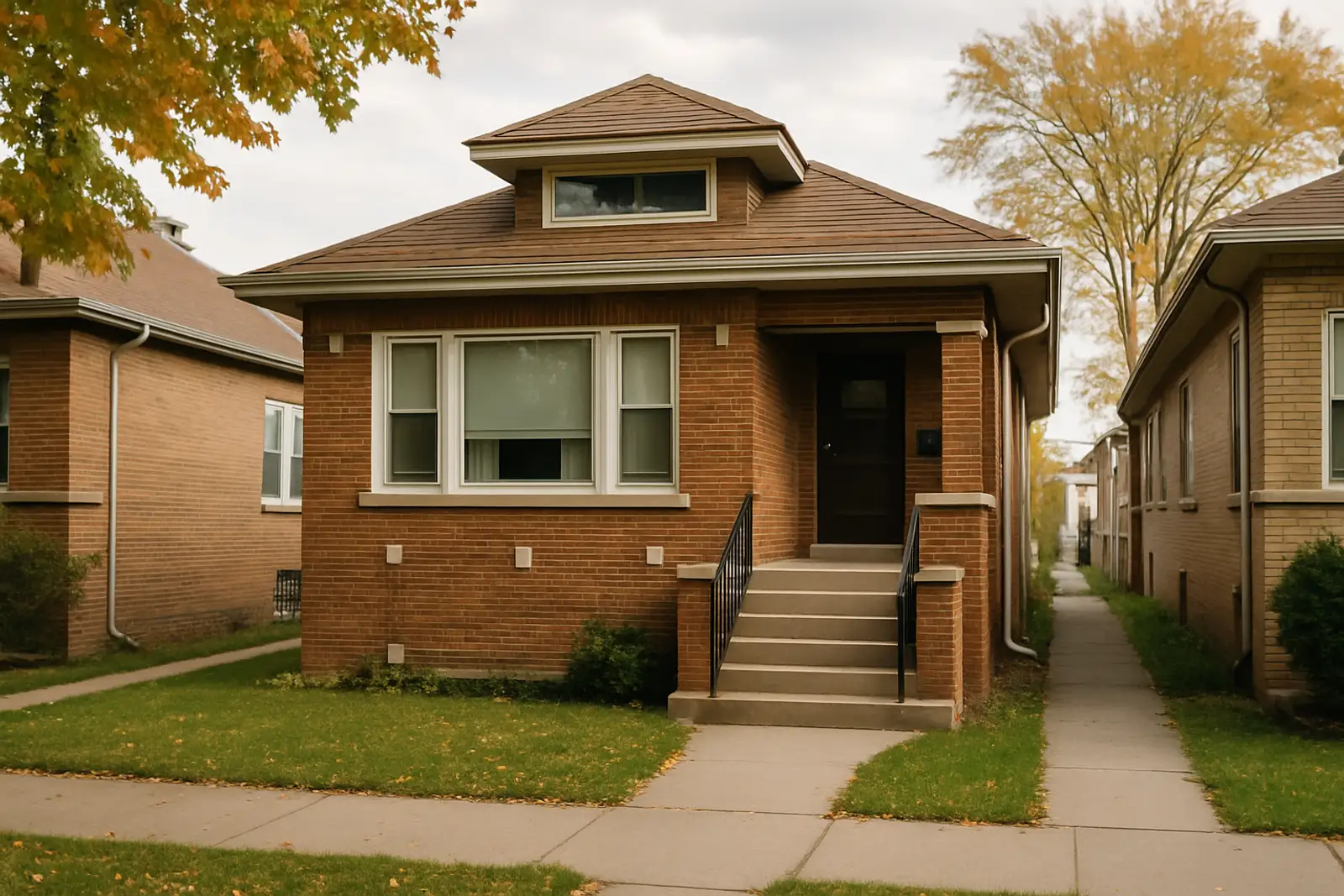
Houses and pipes in Chicago
The Bungalow Belt, a ring of brick bungalows built from about 1910 to 1940 on the Northwest, Southwest and South Sides, makes up a huge share of Chicago's housing, nearly all with basements and clay tile or cast iron sewer lines.
Two-flats, three-flats and greystones fill neighborhoods like Logan Square, Pilsen, Bridgeport, Humboldt Park and Lakeview, often with several households sharing one old sewer line and a basement unit at the bottom.
Many Chicago homes have basements built below street level, with the house sewer running out through the front wall at or above the basement floor, so basement fixtures often drain through overhead sewers or sump-style ejector pits.
Chicago's combined sewers carry both storm water and household sewage in the same pipes, so heavy rain can overwhelm them and push water back up through basement floor drains.
Newer construction, including townhomes and condo buildings from the 1990s onward, has PVC or modern cast iron drains, but most of the city's housing stock is more than eighty years old.
Who handles what in Chicago
The Chicago Department of Water Management maintains the public sewer mains, and the Metropolitan Water Reclamation District treats the wastewater and operates the Deep Tunnel. In Chicago, the private building sewer from the house to the main, including the connection under the parkway, belongs to the property owner.
Drain problems Chicago homes see most
| Problem | Why it happens here |
|---|---|
| Basement flooding after storms | Combined sewers citywide |
| Roots in clay tile | Bungalow Belt parkway trees |
| Cast iron corrosion and scale | Pre-war two-flats and bungalows |
| Grease buildup | Multi-unit buildings and restaurant corridors |
| Ejector and overhead sewer trouble | Below-grade basement bathrooms |
| Frozen lines | Garages, porches and exterior walls in January |
Chicago drains through the year
Spring and summer thunderstorms are the big risk: a few inches of rain in an hour can surcharge the combined sewers and send water up through basement drains across whole neighborhoods. Roots also push hardest from May through August.
January and February bring subzero cold and lake-effect wind that freeze drains in unheated back porches, garages and along exterior basement walls.
What drain cleaning costs in Chicago
| Job | Typical range |
|---|---|
| Sink, tub or toilet cleared | $150–$310 |
| Main line cleared from a cleanout | $225–$495 |
| Root cutting | $290–$650 |
| Hydro jetting | $385–$900 |
| Sewer scope inspection | $155–$310 |
| Backwater valve or flood control check | $200–$450 |
Clear access to a front-wall cleanout keeps costs down. Root-filled clay under parkway trees, multi-unit buildings and lines that run under the street take longer.
Before the plumber arrives
- 1
Stop water use
If you're in a two-flat, let upstairs neighbors know to hold off on water too.
- 2
Is it raining hard?
If it's storming and several homes on the block have water, the city sewer may be surcharged. Report it to 311.
- 3
Check the basement
Note whether water is coming up the floor drain, the laundry tub or a basement toilet.
- 4
Find the cleanout
Usually on the front basement wall where the sewer leaves the house, sometimes with a big brass or iron plug.
The Bungalow Belt
Between roughly 1910 and 1940, builders put up tens of thousands of brick bungalows across neighborhoods like Portage Park, Jefferson Park, Chicago Lawn, Gage Park, Brainerd and Chatham. They share a recognizable plan: a narrow lot, a full basement, a front porch, and a sewer that leaves through the front basement wall and runs under the yard and parkway to the main in the street. The clay tile used for many of those lines has had nearly a century to crack, and the elms and later the ash, maple and honey locust trees planted along the parkways have sent roots into the joints.
Bungalow owners often call when the basement floor drain backs up after laundry, a sign the main line is partly blocked. Root cutting reopens the pipe, and a camera inspection shows whether the clay needs lining or a spot repair.
Two-flats and greystones
The two-flat is as Chicago as the bungalow. Brick two-flats and stone-fronted greystones in Logan Square, Pilsen, Little Village, Bridgeport, Lakeview and Humboldt Park often house two or three households plus a garden unit in the basement. Everyone shares one building sewer, so a clog upstairs can send water into the garden unit below. Grease from several kitchens, hair from several bathrooms and wipes all add up. Building owners who jet the main every year or two prevent most emergencies.
Combined sewers and the Deep Tunnel
Chicago was one of the first American cities to build a citywide sewer system, and it did so by raising the grade of downtown streets in the 1850s and 1860s, jacking up buildings or adding a new ground floor. Most of the city still runs on combined sewers. The Metropolitan Water Reclamation District's Tunnel and Reservoir Plan, known as the Deep Tunnel, stores huge volumes of storm water to reduce flooding, but intense summer storms can still overwhelm local sewers. When that happens, water rises in the main and looks for the lowest exit, which is often a basement floor drain.
Backwater valves, standpipe plugs for floor drains and overhead sewer conversions are common flood control measures. The city has offered rebate programs in some years, so it's worth checking before you install.
Basements below the sewer
In many Chicago homes the main sewer exits the basement at or near the ceiling level of the basement, or only slightly below the floor, because the streets were raised. Basement bathrooms and laundry rooms added later often drain into an ejector pit with a pump. If the pump fails or a float sticks, the basement backs up even when the main line is clear. Testing the pump each spring before storm season is smart.
A typical Chicago call
On a humid July night, after a two-inch downpour, a family in a 1926 bungalow in Portage Park finds an inch of water around the basement floor drain. The rain stops, but the water doesn't go down. The plumber opens the front-wall cleanout, cuts out a mass of roots under the parkway where a big maple stands, and the water drains away. The camera shows a cracked clay joint. The family books a liner and looks into adding a backwater valve.
Cast iron in old buildings
Many pre-war Chicago buildings have cast iron stacks and drains inside the walls and under the basement floor. After eighty or a hundred years, cast iron scales and corrodes from the inside, narrowing the pipe and creating rough surfaces that catch grease and paper. Descaling with specialized cutters or hydro jetting restores the flow, and a camera inspection shows whether the pipe is still sound enough to keep.
Restaurant corridors
From Devon Avenue and Argyle Street to 26th Street in Little Village, Chinatown, Randolph Street and Taylor Street, Chicago has some of the busiest restaurant corridors in the country. Commercial kitchens in old buildings need their grease traps pumped regularly and their lines jetted to prevent backups that can shut a restaurant down on a Friday night. The city requires grease control for food service establishments, and inspectors check.
Winter in Chicago
Chicago winters are long, and when a polar vortex sends temperatures well below zero, drains and supply lines in unheated back porches, garages, crawlspaces and exterior walls freeze. Laundry lines on enclosed back porches, a classic two-flat setup, are a common trouble spot. Keep heat on in those spaces, wrap exposed pipe and let a faucet drip on the coldest nights. Thaw frozen lines with gentle heat, never an open flame.
Buying in Chicago
A sewer scope is one of the most valuable inspections when buying a bungalow, two-flat or greystone. Ask the inspector to run the camera from the front-wall cleanout all the way to the main under the street. Watch the full video for roots, cracks, offsets and sags. A sewer repair under the parkway or street can be expensive, so get an estimate before closing.
What to tell a Chicago plumber
Give your neighborhood, the building type (bungalow, two-flat, greystone, frame cottage or newer condo) and the age. Say whether it rained hard before the backup, whether neighbors also have water and whether the basement has an ejector pit or overhead sewer. Mention any big parkway trees and how many units share the line.
Chicago ZIP codes
- 60018
- 60601
- 60602
- 60603
- 60604
- 60605
- 60606
- 60607
- 60608
- 60609
- 60610
- 60611
- 60612
- 60613
- 60614
- 60615
- 60616
- 60617
- 60618
- 60619
- 60620
- 60621
- 60622
- 60623
- 60624
- 60625
- 60626
- 60628
- 60629
- 60630
- 60631
- 60632
- 60633
- 60634
- 60636
- 60637
- 60638
- 60639
- 60640
- 60641
- 60642
- 60643
- 60644
- 60645
- 60646
- 60647
- 60649
- 60651
- 60652
- 60653
- 60654
- 60655
- 60656
- 60657
- 60659
- 60660
- 60661
Chicago drain questions
Who is responsible for my sewer in Chicago?+
The city maintains the public main. The building sewer from your house to that main, including the section under the parkway, is the property owner's responsibility.
Why does my basement flood when it rains?+
Most of Chicago has combined sewers that carry storm water and sewage together. In heavy storms they fill up and can push water back through the lowest drains in your house. A backwater valve or overhead sewer conversion can help.
What is an overhead sewer?+
It's a setup where basement fixtures drain into an ejector pit, and a pump lifts the waste up to a sewer line that exits high on the wall. Because the basement has no direct connection to the street sewer, surcharged water can't come up through the floor drain.
Should I scope the sewer before buying a bungalow or two-flat?+
Yes. Clay and cast iron lines in pre-war buildings often have roots, cracks or sags, and repairs under the parkway or street can be costly.